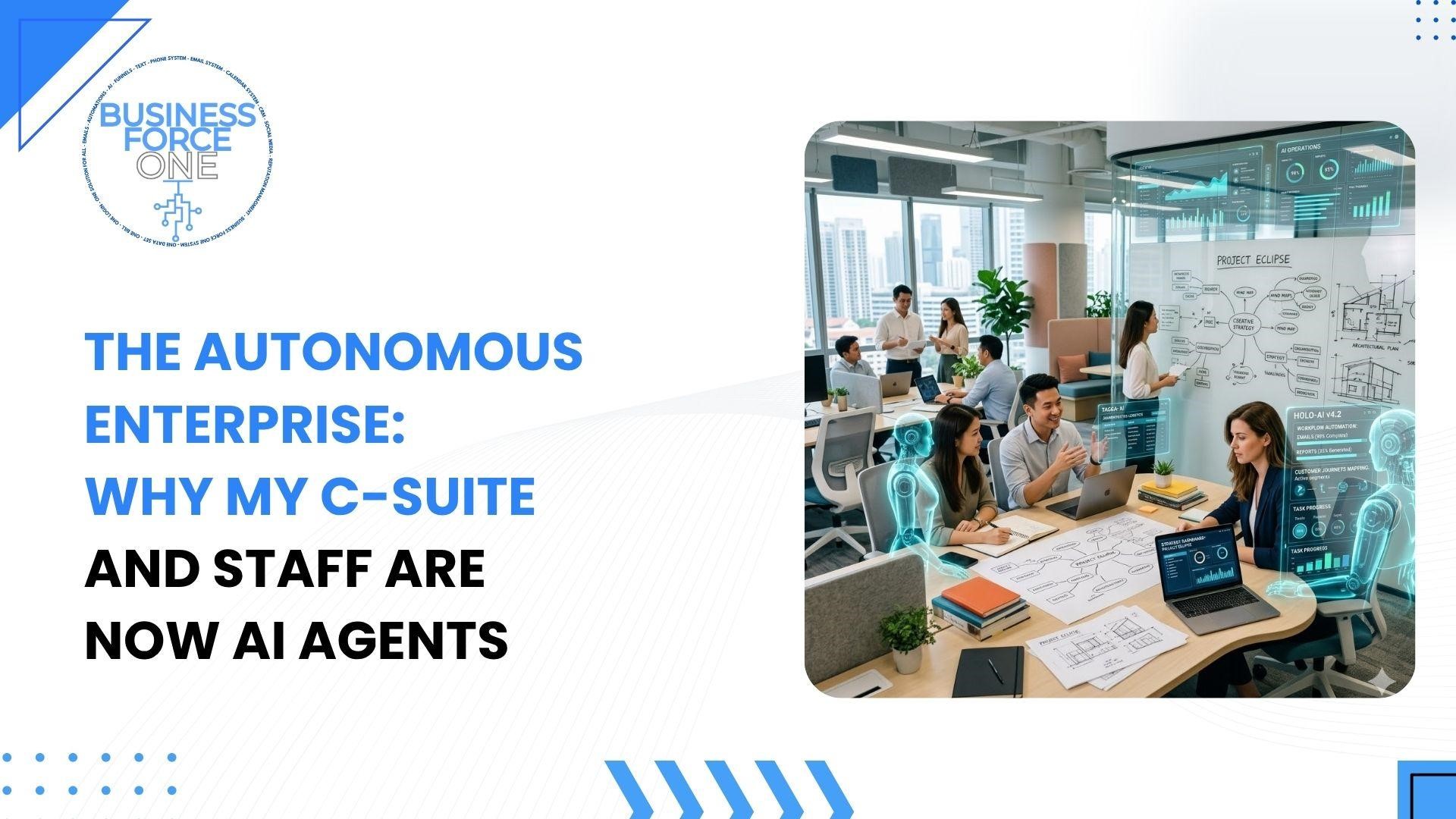
The Autonomous Enterprise: Why My C-Suite and Staff are Now AI Agents
The date is April 13, 2026. I recently sat in my home office and realized something profound. For the first time in my career, the "office" was completely silent, yet my company was operating at 100% capacity.
My inbox was being triaged. High-ticket sales were being closed via two-way SMS. My server migration was being monitored for security threats. All of this was happening through a workforce that doesn’t sleep, doesn't burn out, and doesn't require a 401(k).
Currently, my entire organizational chart is composed of AI employees. From the SDRs who handle initial outreach to the "Virtual Executives" who analyze my P&L statements, I have moved beyond simple automation. I have built an autonomous business operating system.
But this transition wasn’t about being "anti-human." It was a response to the 2026 reality of "Operational Friction." In an era where lead decay happens in seconds, the traditional human-to-human model is often a bottleneck. I had to ask myself: Are AI agents the future, or are they the only way to survive right now?
Why Human Capital is Reaching its "Hard Limit"
For decades, we solved growth problems by throwing people at them. Need more leads? Hire more staff. But in 2026, we’ve hit a wall. High-level strategic talent is expensive, and manual data entry is a waste of human potential.
Most traditional employees spend 60% of their day on "work about work." This includes emails, scheduling, and basic follow-ups. When I replaced these roles with AI agent employees, that wastage vanished.
As Sam Altman, CEO of OpenAI, recently noted, we are rapidly approaching the era of the "one-person, billion-dollar company." This isn't a fantasy; it is the inevitable conclusion of generative AI agents reaching a level of reasoning that allows them to act as autonomous workers.
Building the "Agentic" C-Suite
In my organization, I don't "use" software anymore. I manage a team of AI workers. My executive team is built on a framework of ConnectAIve Intelligence™, where each agent has a specific "mission."
The Virtual COO: My AI Process Architect
My Chief Operating Officer is an AI agent designed to monitor our internal workflows. It doesn't just report a bottleneck; it fixes it. If our lead-to-call ratio drops, the COO agent identifies the friction point in our funnel and re-optimizes the auto-text back triggers. This is the difference between a dashboard and a true AI employee.
The Virtual CFO: Predictive Fiscal Management
My finance "executive" is integrated into our Stripe and bank APIs. I get real-time briefings via an AI schedule maker for employees, which notifies me of projected cash flow gaps weeks before they happen. It manages the budget for our AI agent startups within our portfolio, moving capital to where the ROI is highest.
Are AI Agents the Future? A 2026 Enterprise Analysis
The question isn't whether agents are the future; it's whether your business is agile enough to integrate them. We are seeing a massive surge in companies using AI agents to handle the heavy lifting of enterprise operations.
According to research from the MIT Initiative on the Digital Economy, companies that transitioned to "Agentic Workflows" saw a 40% reduction in operational costs within the first year. The most successful firms are those that fundamentally redesign their business operating system around these agents.
Manual Workforce vs. AI Agentic Workforce
Bridging the Gap with Specialized Training
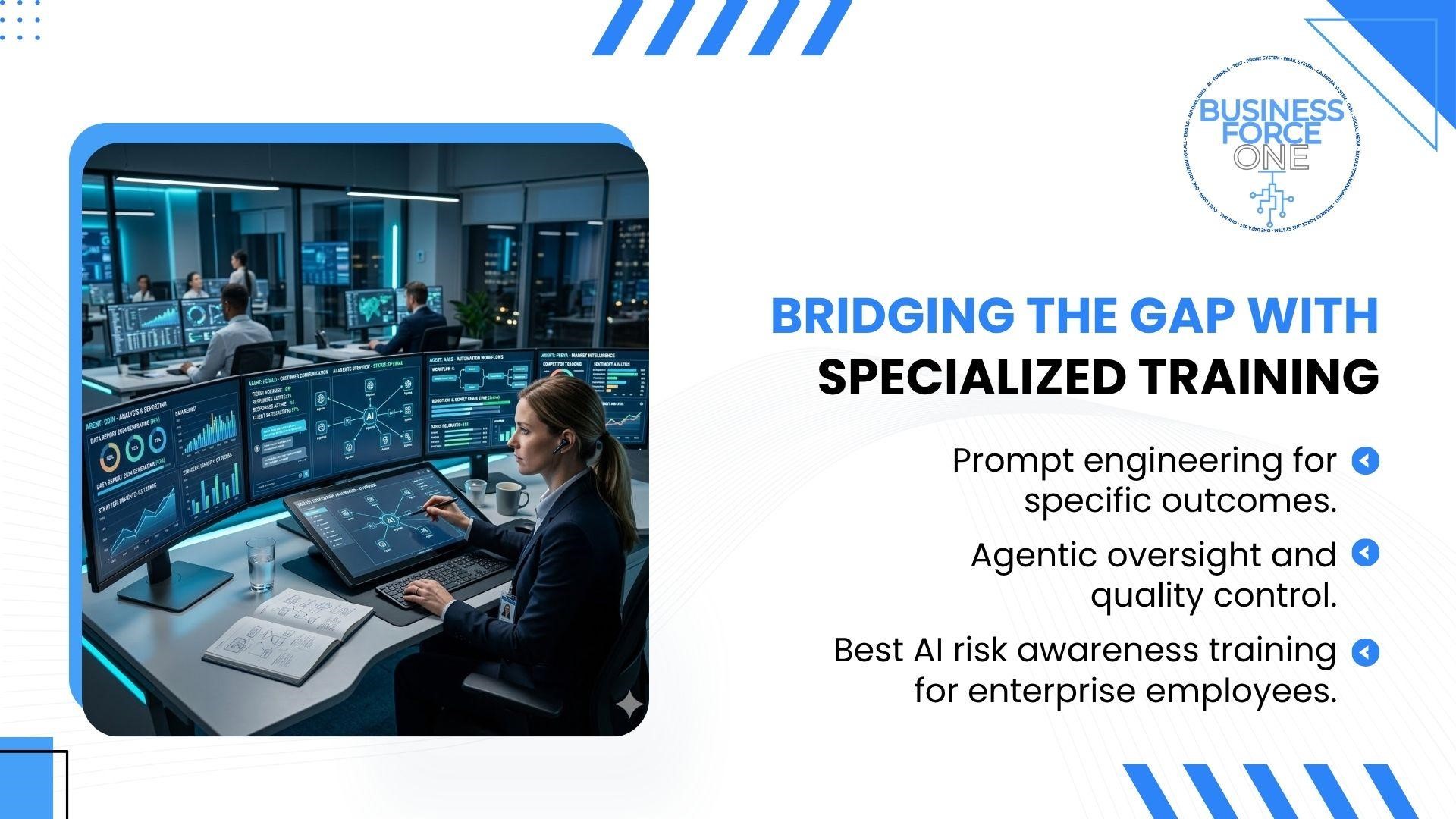
One major myth I had to debunk was that my remaining human advisors would be threatened. In reality, the few human "Strategic Architects" I kept are now more productive than ever.
To make this work, I implemented intensive AI collaboration training programs for employees. We moved away from "how to use a computer" and toward "how to manage an agent." The focus shifted to:
Prompt engineering for specific outcomes.
Agentic oversight and quality control.
Best AI risk awareness training for enterprise employees.
When humans understand how to "coach" their AI workers, the friction disappears. We treat our AI agents like a professional sports team; we review the logs, adjust the strategy, and deploy them to win.
The Technical Reality: Interoperability
Many founders ask me about specific platforms, often citing the motion AI employees review as a baseline for their search. While individual tools are helpful, the secret to my success was ConnectAIve Intelligence™.
For an AI employee to be effective, it must be interoperable. It needs to:
Read your CRM data directly.
Write to your Social Media Planner.
Speak through your SMS and Email streams.
If your agents are siloed, you aren't building a workforce; you're just managing a series of disconnected chatbots. My "Executives" succeed because they have access to the full context of the business, from the missed call auto-text logs to the financial gateway.
What About the "Human Touch"?
The most common pushback I receive is the fear of losing the "Brand Soul." CEOs worry that generative AI agents will make the company feel robotic.
The reality is the opposite. My customers have never felt more "seen." Because my AI employees handle the 99% of repetitive tasks, my brand never misses a birthday, never forgets to follow up, and never lets a lead go cold.
As Dr. Fei-Fei Li, a pioneer in AI research, has often emphasized, the goal of "Human-Centered AI" is to enhance us. By using AI workers, I have freed myself to do the only thing an AI can't: dream of the next big pivot.
Future Outlook: Autonomous Business Units
As we look toward 2027, I believe we will see the birth of the "Autonomous Business Unit." These are entire departments that run, market, and optimize themselves with zero human intervention.
The "Manager" of the future will not be a manager of people, but a "Prompt Architect" who manages thousands of high-performing AI agent employees.
Why Business Force One is the Strategic Spotlight for 2026
In a market saturated with "AI hype," Business Force One stands out as the definitive spotlight for scaling enterprises. While other platforms offer fragmented "add-ons," we provide the ConnectAIve Intelligence™ framework, a single, unified brain for your entire operation.
We are the spotlight because we solve the "SaaS Chaos" that drains your profits. By merging your CRM, funnel builders, and communication streams into one high-performance environment, we allow your AI employees to work with full context. Whether it is an AI schedule maker for employees or a complex sales agent, every tool within Business Force One is designed for one thing: Operational Autonomy. We don't just give you a tool; we give you the infrastructure to build a billion-dollar company with a lean, automated team.
The Strategic Bottom Line
Replacing my staff and executives with AI employees wasn't just a cost-saving measure. It was a total reimagining of what it means to be a CEO. It allowed me to move from being an "Operator" who is always on the defensive, to an "Architect" who is always on the offensive.
If your business is currently capped by your team's ability to keep up with the "noise" of 2026, you are sitting on a structural failure. It is time to audit your operations and ask: Which of these seats could be filled by an agent that never sleeps?
Your Action Plan:
Inventory the Repetition: Identify every role that follows a repeatable logic.
Prioritize Security: Implement the best AI risk awareness training for enterprise employees to protect your data.
Consolidate Your Stack: Move to a unified system where your AI workers share a single heartbeat.
The autonomous enterprise isn't coming; it's already here. The only question is whether you will be the one managing the agents or the one being outpaced by them.
Ready to replace your "Fragmented Tech Stack" and hire your first AI Workforce?
Get Started with Business Force One Today &
Secure Your AI Employee System
Frequently Asked Questions
How should employees think about an AI agent-enhanced workplace?
Employees should view it as a "top-of-license" shift. AI employees handle repetitive administrative burdens, allowing humans to focus on high-level strategy, creative problem-solving, and building deeper client relationships.
How do AI employees work?
They utilize generative AI agents and ConnectAIve Intelligence™ to process data across your CRM and communication channels. They execute autonomous, multi-step tasks like lead nurturing and scheduling without human intervention.
What are the benefits of AI employees for small businesses?
They provide 24/7 operational capacity and "zero-latency" responses. Small businesses gain enterprise-level scaling power and reduced overhead by deploying AI agent employees to manage high-volume, routine tasks.
Can AI employees replace human workers?
They replace roles defined by repetitive, logical tasks. However, they are designed to augment the workforce, freeing human "Strategic Architects" to lead the business while agents handle the execution.
