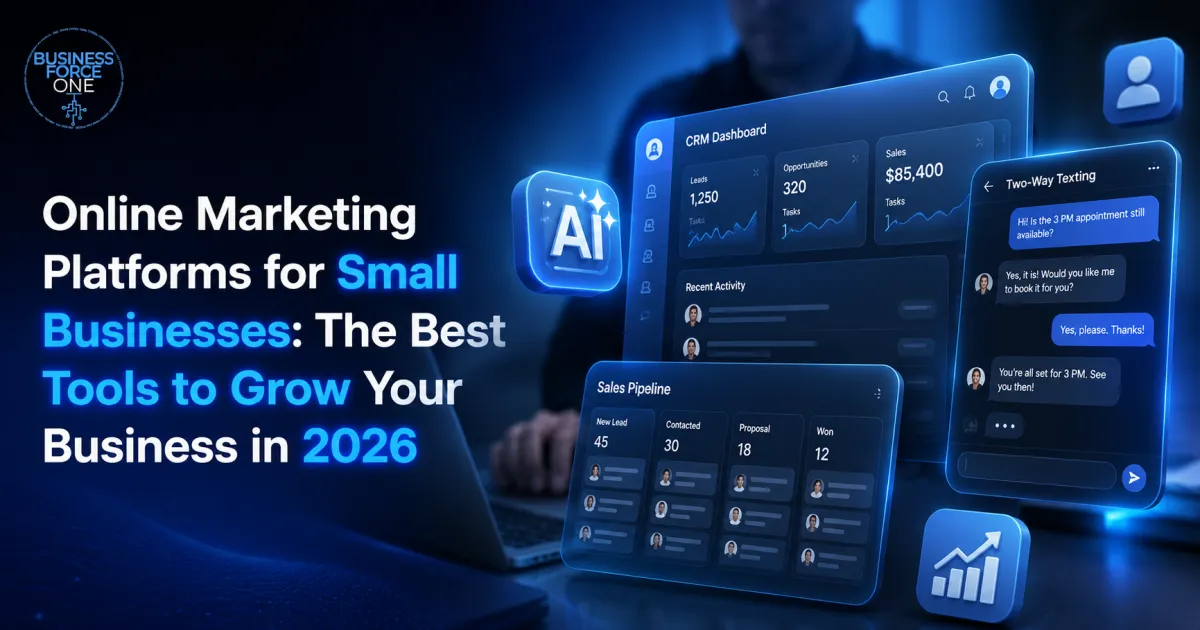
The Best Online Marketing Platforms for Small Businesses to Scale Faster in 2026
Table of Contents
Why Choosing the Right Marketing Platform Matters
What Is an online marketing platform for small businesses?
Must-Have Features Every Small Business Needs
Comparing the Best Marketing Platforms in 2026
Why All-in-One Platforms Are Replacing Multiple Apps
How AI Is Changing Small Business Marketing
Choosing the Right Platform for Your Business
Final Thoughts
FAQs
Why Choosing the Right Marketing Platform Matters
Running a small business in 2026 isn't just about offering a great product or service. It's about being visible everywhere your customers are and responding faster than your competitors.
The challenge?
Most entrepreneurs start with one marketing tool. Then they add another for email campaigns. Another for social media. Another for CRM. Another for scheduling. Before long, they're juggling 10 to 20 different subscriptions that don't communicate with one another.
Instead of saving time, they're spending hours switching between dashboards, copying customer data, and manually following up with leads.
Sound familiar?
This is exactly where the right online marketing platform for small businesses makes all the difference.
Rather than forcing you to manage disconnected software, today's best platforms combine marketing, customer management, automation, AI, and communication into one intelligent system.
The result?
More qualified leads.
Faster follow-ups.
Lower software costs.
And most importantly, more time to focus on growing your business instead of managing it.
What Is an online marketing platform for small businesses?
An online marketing platform for small businesses is an integrated software solution designed to help companies attract customers, nurture relationships, automate marketing campaigns, and track business performance from one centralized dashboard.
Instead of purchasing separate software for every task, these platforms combine multiple business functions under one roof.
Typically, they include:
CRM and lead management
Website and funnel builders
Email marketing
SMS automation
Social media scheduling
Customer messaging
Analytics
Appointment scheduling
AI-powered marketing tools
Think of it as the digital operating system for your business.
The best platforms don't just help you market your business, they help you run it more efficiently.
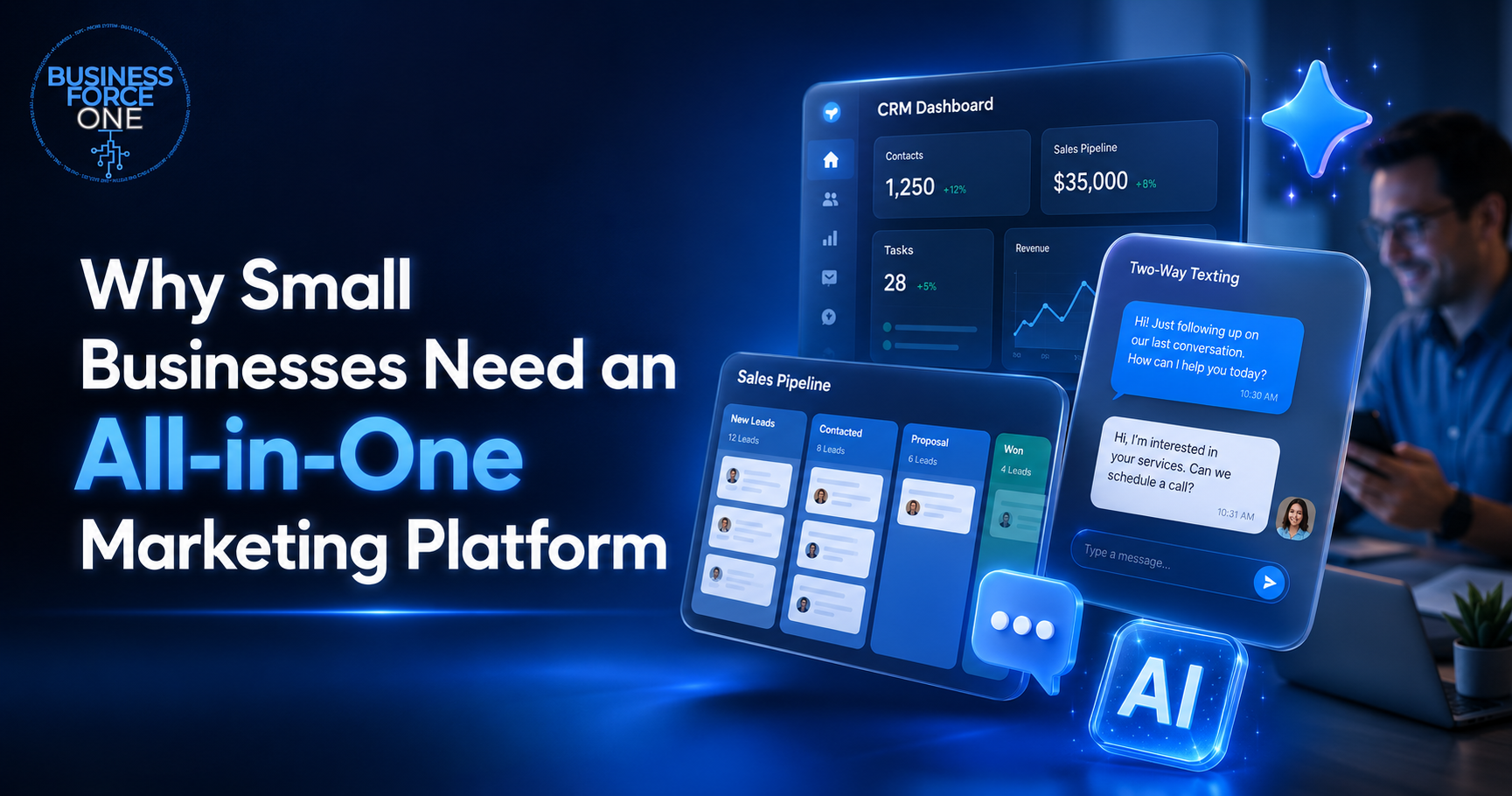
Why Small Businesses Need an All-in-One Marketing Platform
I've worked with enough entrepreneurs to notice a common pattern.
Most aren't struggling because they lack ambition.
They're struggling because their systems can't keep up with their growth.
One spreadsheet tracks leads.
Another tool sends emails.
Appointments are managed elsewhere.
Customer conversations happen across Facebook Messenger, text messages, email, and phone calls.
Nothing is connected.
Every manual step increases the chance of missing a lead or delaying a response.
And in today's competitive market, delayed responses often mean lost revenue.
An all-in-one platform changes that completely.
Instead of chasing customers across multiple apps, every interaction happens in one place.
Your website captures the lead.
Your CRM stores the information.
Automation sends follow-up messages.
AI qualifies prospects.
Appointments are booked automatically.
Sales pipelines update themselves.
That's not just automation.
That's operational freedom.
Must-Have Features Every Marketing Platform Should Include
Not every platform deserves your investment.
Before choosing one, make sure it offers features that actually contribute to business growth—not just a long checklist.
Customer Relationship Management
A reliable crm platform for small businesses helps organize customer information, monitor conversations, track opportunities, and ensure no lead slips through the cracks.
Without a CRM, scaling becomes increasingly difficult because customer information ends up scattered across different systems.
Marketing Automation
Automation is no longer optional.
The best platforms automatically send emails, SMS reminders, appointment confirmations, review requests, and follow-up campaigns based on customer behavior.
Instead of manually remembering every task, your system does the work for you.
Website and Funnel Builder
Your website should generate leads, not simply provide information.
Modern platforms include drag-and-drop builders that allow businesses to create landing pages, sales funnels, forms, and lead capture pages without hiring developers.
This becomes especially important for every growing business e-commerce platform looking to increase online conversions.
AI-Powered Assistance
One of the biggest shifts happening in 2026 is the rapid adoption of ai platforms for business.
AI can now:
Generate marketing copy
Respond to customer questions
Qualify leads
Schedule appointments
Create landing page content
Draft emails
Analyze customer conversations
Instead of replacing your team, AI helps your existing team accomplish significantly more in less time.
Unified Communication
Customers expect immediate responses.
Whether someone contacts you through Facebook Messenger, SMS, live chat, email, or your website, every conversation should appear inside one communication platform for business. This eliminates confusion while dramatically improving customer experience.
Comparing the Best Marketing Platforms in 2026
If you've researched marketing software recently, you've probably seen the same names appear repeatedly.
Each platform excels in different areas.
HubSpot
HubSpot remains a strong option for growing businesses thanks to its CRM, marketing automation, reporting, and educational resources.
It's user-friendly but can become expensive as your business scales.
Mailchimp
For companies primarily focused on newsletters and email campaigns, Mailchimp continues to be one of the leading email marketing platforms for small businesses.
However, businesses often need additional software for CRM, sales pipelines, automation, scheduling, and reputation management.
Canva
Canva has transformed content creation by making professional design accessible to non-designers.
It's excellent for creating social media graphics, presentations, ads, and promotional materials.
Semrush
When improving search visibility is your priority, Semrush remains one of the strongest SEO research platforms.
It helps businesses identify keyword opportunities, monitor rankings, and analyze competitors.
However, it focuses on SEO rather than complete business operations.
Business Force One
Many entrepreneurs eventually realize that using five or six separate platforms creates unnecessary complexity.
That's where Business Force One takes a different approach.
Instead of offering a single marketing feature, it combines website creation, funnels, CRM, automation, AI content generation, messaging, reputation management, analytics, scheduling, and sales tracking into one unified ecosystem.
For business owners trying to reduce software costs while increasing efficiency, this all-in-one model simplifies daily operations without sacrificing advanced capabilities.
Rather than spending your day connecting disconnected tools, your business runs through one intelligent platform designed specifically for entrepreneurs who want sustainable growth.
Why All-in-One Platforms Are Replacing Traditional Marketing Stacks
A few years ago, using multiple marketing tools seemed like the smart approach. You'd have one platform for email marketing, another for customer management, another for social media scheduling, and several more for analytics, reviews, and automation.
Today, that strategy creates more problems than it solves.
Every disconnected tool means another login, another monthly subscription, another integration, and another opportunity for customer data to fall through the cracks. Instead of creating efficiency, businesses often spend valuable hours switching between platforms just to complete one customer journey.
Imagine this scenario.
A potential customer fills out a form on your website. That information should instantly appear in your CRM, trigger a welcome email, notify your sales team, schedule a follow-up, and begin a personalized nurture campaign. If those systems aren't connected, someone on your team has to do the work manually.
That's exactly why modern businesses are moving toward unified platforms.
Business Force One brings your website, CRM, automation, messaging, AI tools, analytics, scheduling, and reputation management together in one dashboard. Rather than managing software, you manage growth.
The biggest advantage isn't just convenience it's consistency. Every lead receives the right message at the right time without depending on manual effort.
How AI Is Reshaping Marketing for Small Businesses
Artificial intelligence has quickly evolved from being a competitive advantage to becoming a business necessity.
In 2026, successful businesses won't simply use AI to create content. They'll use it to automate operations, qualify leads, improve customer experiences, and make faster business decisions.
Modern AI platforms for business are capable of handling tasks that previously required entire teams.
For example, AI can:
Generate personalized marketing content
Respond to customer inquiries 24/7
Score and qualify new leads
Schedule appointments automatically
Build landing pages and sales funnels
Recommend follow-up actions based on customer behavior
This doesn't replace human relationships.
Instead, it removes repetitive administrative work so business owners can spend more time building relationships and growing revenue.
Business Force One takes this concept even further with its AI Employee suite. Rather than offering isolated AI features, it integrates AI directly into your marketing workflows, customer communication, and sales process, creating a true digital workforce that operates around the clock.
Don't Ignore Your social media platforms for business
Social media continues to be one of the most effective ways to build trust and attract new customers.
However, posting consistently across multiple channels can become overwhelming for small teams.
The best social media platforms for business are no longer just publishing tools. They help businesses schedule content, monitor engagement, respond to customer messages, and measure campaign performance from a centralized dashboard.
More importantly, they work alongside your CRM.
When someone comments on your content, clicks your advertisement, or sends a message, that interaction should become part of your customer journey not disappear inside another disconnected app.
Integrating social media with your marketing platform creates a seamless experience that improves response times, increases conversions, and strengthens customer relationships.
Why Your communication platform for business Matters More Than Ever
Customers don't think in channels.
They simply expect quick responses.
Some people prefer email.
Others send text messages.
Many start conversations through Facebook Messenger or live chat.
If your team has to monitor every platform separately, delays become inevitable.
A modern communication platform for business brings every conversation into one inbox, allowing your team to respond faster while maintaining complete visibility into each customer's history.
When communication is unified with your CRM and automation, every conversation becomes an opportunity to build trust, solve problems, and generate additional revenue.
Choosing the Right Business Networking Platform
Marketing isn't only about attracting customers. It's also about building valuable relationships.
A quality business networking platform helps entrepreneurs connect with potential partners, referral sources, suppliers, and industry experts who can accelerate business growth.
While traditional networking still has value, digital networking has become equally important.
Look for platforms that allow you to:
Build meaningful professional relationships
Join industry communities
Share expertise
Generate referral opportunities
Expand your brand authority
The stronger your professional network becomes, the easier it is to generate long-term business opportunities beyond paid advertising.
How to Choose the Best online marketing platform for small businesses
Every business has different goals, but the evaluation process should remain the same.
Ask yourself a few practical questions.
Can this platform grow with my business?
Will it reduce the number of software subscriptions I'm paying for?
Does it automate repetitive tasks?
Can my team learn it quickly?
Does it integrate AI into everyday workflows?
Most importantly, will it help me spend less time managing software and more time serving customers?
If the answer to those questions is yes, you've likely found a platform worth investing in.
The best online marketing platform for small businesses isn't necessarily the one with the longest feature list. It's the one that removes friction from your daily operations and helps your business scale efficiently.
The Future Belongs to Businesses That Automate
Marketing has changed dramatically over the past few years.
Customers expect instant communication.
Competition is increasing.
Advertising costs continue to rise.
Businesses that still rely on manual processes will find it increasingly difficult to compete.
The companies that thrive in 2026 will be those that embrace automation, centralize customer data, and use AI to deliver better experiences without increasing operational complexity.
Whether you're launching your first business or expanding an established company, investing in the right online marketing platform for small businesses today creates the foundation for sustainable growth tomorrow.
Instead of working harder every year, build systems that work harder for you.
Ready to Put Your Business on Autopilot?
Growing your business shouldn't require juggling dozens of disconnected tools or hiring a larger team just to keep up with daily operations.
Business Force One gives entrepreneurs everything they need in one powerful platform, from CRM and sales automation to AI-driven marketing, websites, funnels, messaging, scheduling, analytics, and reputation management.
Imagine replacing multiple subscriptions with one intelligent system that captures leads, nurtures prospects, automates follow-ups, and helps you close more deals while you focus on growing your business.
Start your Business Force One journey today and discover how one platform can simplify your operations, increase productivity, and help you scale with confidence in 2026 and beyond.
Frequently Asked Questions
What is a business intelligence platform?
A business intelligence platform collects, organizes, and analyzes business data to help companies make informed decisions. It provides dashboards, reports, and performance insights that improve marketing, sales, and operational efficiency.
What is a business platform?
A business platform is a centralized software solution that helps companies manage different aspects of their operations, including customer relationships, marketing, sales, communication, automation, and reporting from one integrated system.
What is a business networking platform?
A business networking platform is an online space where professionals and organizations connect to build partnerships, exchange knowledge, generate referrals, and discover new business opportunities.
What are AI platforms for business?
AI platforms for business use artificial intelligence to automate repetitive tasks, generate content, improve customer communication, analyze data, and optimize business processes. They help organizations work more efficiently while reducing manual effort.
