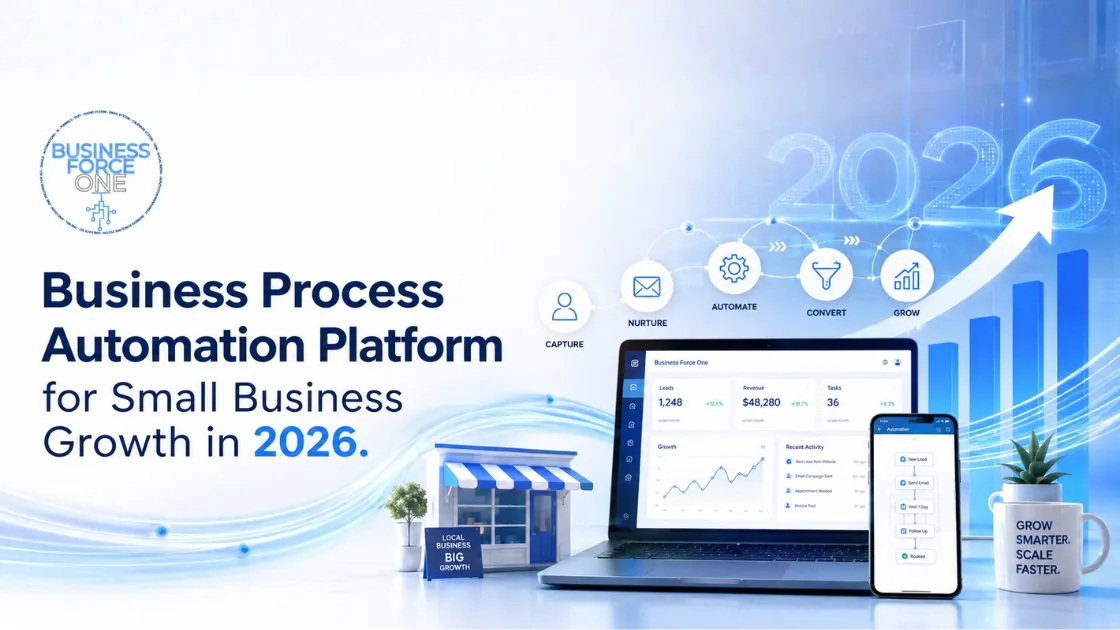
Business Process Automation Platform for Small Business Growth in 2026
Introduction
Running a business today isn't just about working hard; it's about working smart.
Every entrepreneur starts with a vision. Then reality kicks in. Leads begin coming in from different channels. Customers expect instant responses. Appointments need scheduling. Follow-ups pile up. Invoices wait to be sent. Marketing campaigns demand constant attention. Before long, you're spending more time managing software and repetitive tasks than actually growing your business.
That's the real problem.
Manual work creates bottlenecks. Teams waste hours switching between different applications, copying information, chasing leads, and repeating the same processes every single day. These small inefficiencies quietly eat away at productivity, revenue, and customer experience.
The good news? There's a better way.
Business process automation has evolved dramatically in 2026. It's no longer just about automating emails or setting reminders. Today's automation combines artificial intelligence, intelligent workflows, CRM technology, and real-time communication into one connected system that keeps your business running around the clock.
At Business Force One, we believe your business should work for you, not the other way around. By replacing disconnected software with one AI-powered platform, entrepreneurs can eliminate repetitive work, improve customer experiences, and create scalable systems that continue generating results long after the workday ends.
In this complete guide, you'll learn how modern business process automation works, why it's become essential for growing businesses, the exact business process automation steps to follow, and how AI is transforming everyday operations into intelligent, automated systems.
What Is Business Process Automation?

If you define business process automation in the simplest possible way, it means using technology to automate repetitive business tasks that normally require manual effort.
Instead of employees spending hours moving data between systems, sending follow-up emails, scheduling appointments, assigning leads, or updating spreadsheets, automation software performs these actions automatically based on predefined rules or AI-powered decision-making.
Modern business process automation goes far beyond simple workflows.
Today's platforms combine:
workflow automation
Customer Relationship Management (CRM)
AI assistants
Marketing automation
Lead nurturing
Sales pipeline management
Communication tools
Analytics
Scheduling
Content generation
into one intelligent ecosystem.
Think of it as hiring a digital employee who works 24 hours a day without missing a task.
When a visitor fills out a form on your website, the system can instantly:
Save the lead inside your CRM
Send a personalized welcome email
Deliver an SMS confirmation
Notify your sales team
Schedule a follow-up reminder
Launch a nurturing campaign
Track every interaction automatically
No manual work.
No delays.
No forgotten opportunities.
That's the true power of automating processes in today's AI-driven business environment.
Why Business Process Automation Matters More Than Ever in 2026
Business has changed.
Customers now expect immediate responses, personalized communication, and seamless digital experiences. Waiting several hours—or even a day—to respond to a lead often means losing that opportunity to a faster competitor.
Meanwhile, businesses are managing more digital channels than ever before. Websites, landing pages, email campaigns, text messaging, Facebook Messenger, Google Business Profile, social media, online scheduling, and customer reviews all generate valuable customer interactions.
Managing these manually isn't sustainable.
Modern business process technologies eliminate this complexity by connecting every customer touchpoint into one centralized platform.
Instead of jumping between ten different applications, businesses can manage their entire customer journey from a single dashboard while AI handles repetitive operational tasks behind the scenes.
This shift allows companies to:
Respond faster
Reduce operational costs
Improve customer satisfaction
Increase conversion rates
Scale without constantly hiring additional staff
Rather than replacing people, automation empowers teams to focus on strategic work that actually grows the business.
The Hidden Cost of Manual Operations
Many business owners underestimate how much manual work costs them.
It's rarely one massive problem.
Instead, it's hundreds of small tasks repeated every day.
An employee copies contact information from a form into a spreadsheet.
Someone manually schedules appointments.
Marketing sends follow-up emails one by one.
Sales representatives update pipeline stages after every phone call.
Customer support searches through multiple platforms just to answer one question.
Each task may only take a few minutes.
Together, they consume dozens of hours every week.
Those hours represent lost productivity, slower customer response times, inconsistent service, and missed revenue opportunities.
This is exactly why companies across industries are investing heavily in workflow automation.
Automation removes repetitive administrative work, allowing employees to dedicate their time to customer relationships, creative problem-solving, strategic planning, and revenue-generating activities instead of routine data entry.
Common Business Processes You Should Automate First
Not every workflow needs automation immediately.
The most successful businesses start with repetitive, rule-based tasks that consume the most time while delivering the biggest operational impact.
Some of the highest-value opportunities include lead capture, customer communication, appointment scheduling, follow-up sequences, invoice reminders, reputation management, reporting, and sales pipeline updates.
For example, instead of manually responding to every new inquiry, an AI-powered workflow can immediately qualify leads, send personalized messages, assign opportunities to the correct team member, and schedule appointments all within seconds.
Likewise, customer review requests no longer need to be sent individually. An automated workflow can trigger review invitations after every completed service, helping businesses consistently build stronger online reputations without additional effort.
These seemingly simple automations create a compounding effect over time. Faster response times lead to higher engagement, better customer experiences improve retention, and consistent follow-ups increase conversion rates, all without adding extra workload to your team.
The Evolution from Simple Automation to AI Employees
Traditional automation followed basic "if this, then that" rules.
For example:
"If someone submits a contact form, send a thank-you email."
While helpful, these workflows still required significant human oversight.
Today's AI-powered automation is fundamentally different.
Modern systems don't just execute instructions; they can analyze customer behavior, personalize communication, generate content, answer questions, qualify leads, schedule appointments, and even support outbound conversations through intelligent AI agents.
This evolution transforms automation from a collection of disconnected workflows into what Business Force One calls an AI Employee a digital workforce capable of supporting marketing, sales, customer service, and operational tasks around the clock.
Instead of simply completing tasks faster, businesses gain an intelligent system that continuously supports growth, improves customer engagement, and keeps operations moving even outside traditional business hours.
The Essential Business Process Automation Steps Every Business Should Follow
Many business owners think automation starts with buying software.
It doesn't.
Successful business process automation begins with understanding how your business currently operates. Technology simply accelerates what already exists. If your processes are broken, automation will only make those problems happen faster.
That's why the most successful automation projects follow a structured approach.
Step 1: Identify Your Biggest Operational Bottlenecks
Start by looking at where your team spends the most time every day.
Ask questions like:
Which tasks are repeated every day?
Where do mistakes happen most often?
Which activities require copying information between systems?
Where do customers experience delays?
Which processes prevent your team from focusing on higher-value work?
For many businesses, the answers include lead follow-up, appointment scheduling, customer onboarding, invoice reminders, email campaigns, and internal approvals.
These repetitive activities are often the easiest and most rewarding to automate.
Step 2: Map Your Existing Workflow
Before you automate anything, document how the process currently works.
For example, a typical lead generation workflow might look like this:
A visitor submits a contact form → someone manually reviews the inquiry → the lead is entered into a spreadsheet → an email is sent later that day → the sales team is notified → a follow-up call is scheduled.
Now imagine the same process inside an AI-powered automation platform.
The form submission instantly creates a CRM record, qualifies the lead, assigns it to the correct pipeline, sends a personalized email, delivers an SMS confirmation, notifies the sales representative, and schedules the next follow-up automatically.
The process hasn't changed.
Only the manual work has disappeared.
That's the real value of workflow automation.
Step 3: Choose the Right Automation Platform
Not all automation tools are built for growing businesses.
Many companies end up paying for multiple disconnected platforms: one for CRM, another for email marketing, another for websites, another for SMS, another for scheduling, and yet another for reporting.
The result?
Higher costs.
Disconnected data.
Complex integrations.
More maintenance.
Instead, look for best business process automation software that combines your essential business tools into one centralized ecosystem.
An all-in-one platform should ideally include:
CRM and lead management
Website and funnel builder
Email and SMS automation
Calendar scheduling
AI-powered communication
Workflow builder
Reporting dashboards
Reputation management
Sales pipeline tracking
Content generation tools
When every feature works together, your team spends less time managing software and more time serving customers.
Step 4: Build Intelligent Automation Workflows
Automation isn't about replacing every human interaction.
It's about removing repetitive tasks while improving customer experiences.
For example, imagine someone downloads your free guide.
Instead of waiting hours for a response, your system can immediately:
Send a personalized welcome email.
Deliver a text message confirming the download.
Assign the lead to the appropriate sales pipeline.
Notify your sales team.
Schedule follow-up reminders.
Trigger educational email sequences.
Alert your team when the lead becomes sales-ready.
The customer feels supported.
Your team stays informed.
Nothing gets forgotten.
Step 5: Measure, Improve, and Scale
Automation isn't a "set it and forget it" strategy.
High-performing businesses continuously monitor their workflows to improve performance over time.
Track metrics such as:
Lead response time
Appointment booking rate
Customer conversion rate
Sales cycle length
Follow-up completion
Revenue generated
Customer retention
Small improvements across these metrics often produce significant long-term business growth.
The Benefits of Workflow Automation Extend Far Beyond Saving Time
Most people think automation is simply about working faster.
That's only part of the story.
Modern workflow automation creates measurable improvements across nearly every department.
Better Customer Experiences
Customers don't like waiting.
Automated systems acknowledge inquiries immediately, provide instant updates, send reminders, and maintain consistent communication throughout the customer journey.
That responsiveness builds trust from the very first interaction.
Greater Operational Accuracy
Manual work inevitably leads to mistakes.
Incorrect customer details.
Forgotten follow-ups.
Duplicate entries.
Missed appointments.
Automation dramatically reduces these human errors by ensuring every process follows the same predefined workflow.
Consistency creates reliability.
Reliability creates stronger customer relationships.
Lower Operating Costs
Every software subscription adds another monthly expense.
Every manual task adds labor costs.
Businesses using unified automation platforms often reduce both.
Instead of paying separately for CRM software, email marketing, scheduling, SMS messaging, landing pages, and reputation management, everything operates inside one connected platform.
That means fewer subscriptions, fewer integrations, and lower operational overhead.
More Scalable Growth
One of the biggest challenges growing businesses face is adding more customers without adding more complexity.
Automation makes that possible.
Whether you're serving 100 customers or 10,000, intelligent workflows continue operating with the same consistency.
Growth becomes sustainable instead of overwhelming.
The Role of AI in Modern Business Process Technologies
Traditional automation relied entirely on rules.
Artificial intelligence adds intelligence to those rules.
Rather than simply following predefined instructions, AI can analyze conversations, personalize responses, recommend actions, generate content, and support customer interactions without constant human involvement.
Today's business process technologies combine automation with AI to create systems that continuously improve operational efficiency.
For example, AI can:
Generate marketing emails based on customer behavior.
Draft website content.
Qualify incoming leads.
Answer common customer questions.
Route conversations to the appropriate department.
Summarize customer interactions.
Assist sales representatives with follow-up recommendations.
Generate images and marketing assets.
Support outbound communication.
This transforms automation from task management into intelligent business assistance.
Instead of merely completing repetitive work, AI actively contributes to business growth.
Why Business Process Testing Is Critical Before Scaling
Even the best automation should be tested before it's rolled out across your entire organization.
This is where business process testing becomes essential.
Testing verifies that every workflow behaves exactly as intended before real customers interact with it.
For example, you should confirm that:
Leads enter the correct pipeline.
Emails are delivered successfully.
SMS messages trigger correctly.
Appointment reminders arrive on time.
AI responses remain accurate.
Internal notifications reach the right team members.
Reports display correct data.
Testing also uncovers unexpected issues that could negatively affect customer experiences.
Instead of fixing problems after launch, businesses identify and resolve them early.
That proactive approach creates smoother operations and greater confidence as automation expands across the organization.
Real-World Example: From Administrative Chaos to Scalable Growth
Consider a local service business generating dozens of inquiries every day.
Their team managed appointments manually, responded to emails individually, tracked leads in spreadsheets, and frequently missed follow-up opportunities.
The owner wasn't struggling because of a lack of demand.
They were struggling because their systems couldn't keep up.
After implementing an AI-powered automation platform, every inquiry automatically entered the CRM, triggered personalized email and SMS follow-ups, scheduled appointments, updated sales pipelines, and notified the correct team members.
Within weeks, response times dropped dramatically.
Lead management became consistent.
Administrative workload decreased.
Most importantly, the business owner finally had time to focus on strategy, customer relationships, and expansion instead of repetitive daily tasks.
That's the real promise of automating processes not replacing people, but giving them the freedom to do more valuable work.
Why Local Business Process Automation Services Are Becoming Essential
For years, automation was viewed as something only large enterprises could afford. That mindset has changed completely.
Today, local business process automation services are helping small businesses compete with larger organizations by giving them access to the same level of operational efficiency without the enterprise-level costs or complexity.
Whether you own a home service company, marketing agency, dental practice, law firm, real estate brokerage, fitness studio, or consulting business, your daily operations probably include the same repetitive tasks:
Responding to new inquiries
Booking appointments
Following up with prospects
Sending invoices
Collecting reviews
Managing customer conversations
Tracking sales opportunities
When these tasks rely entirely on manual effort, growth eventually reaches a ceiling.
Automation removes that ceiling.
Instead of hiring additional administrative staff every time your business grows, intelligent workflows scale alongside your customer base. That means you can serve more clients, maintain faster response times, and deliver a consistent customer experience without dramatically increasing operational costs.
For entrepreneurs focused on sustainable growth, investing in local business process automation services is no longer a competitive advantage; it's becoming a business necessity.
How Different Industries Benefit from Business Process Automation
One of the biggest strengths of business process automation is its flexibility.
The same technology can support businesses across nearly every industry while adapting to unique operational needs.
Home Service Businesses
Electricians, HVAC companies, plumbers, roofing contractors, and restoration businesses often rely on quick response times.
Automation helps them instantly capture leads from websites, trigger SMS confirmations, schedule estimates, assign technicians, and request customer reviews after each completed job.
Instead of chasing paperwork, teams stay focused on delivering exceptional service.
Healthcare and Wellness Providers
Medical practices, chiropractors, dentists, and wellness clinics handle hundreds of appointments every month.
Automation simplifies patient scheduling, sends appointment reminders, manages intake forms, delivers follow-up messages, and reduces costly no-shows.
Patients enjoy a smoother experience while staff spend less time handling administrative work.
Marketing Agencies
Agencies manage multiple clients simultaneously, making organization critical.
With workflow automation, agencies can automate proposal delivery, client onboarding, task assignments, campaign reporting, invoice reminders, and recurring communication.
This allows agency teams to spend more time creating results instead of managing operations.
Real Estate Professionals
Speed is everything in real estate.
Automation captures online inquiries, assigns leads instantly, schedules property tours, nurtures prospects through email and SMS campaigns, and keeps agents informed throughout every stage of the buying journey.
No opportunity slips through the cracks.
Coaches and Consultants
Service-based businesses thrive on relationships.
Automation manages discovery calls, onboarding, contracts, invoices, reminders, educational content, and ongoing client communication.
Instead of handling repetitive administrative work, coaches can dedicate more energy to delivering transformational experiences.
Common Mistakes Businesses Make When Automating Processes
Automation is incredibly powerful but only when implemented strategically.
Many businesses rush into automation expecting instant results, only to discover they've automated confusion instead of efficiency.
Here are some of the most common mistakes.
Automating Broken Processes
Technology doesn't fix poor workflows.
If approvals are confusing, customer communication is inconsistent, or data is inaccurate, automation simply repeats those problems faster.
Successful automation starts with improving the process before automating it.
Using Too Many Separate Platforms
One platform manages email.
Another manages CRM.
Another handles scheduling.
Another creates landing pages.
Another sends text messages.
While each tool may perform well individually, managing disconnected systems often creates unnecessary complexity.
Data becomes fragmented.
Integrations fail.
Reporting becomes inconsistent.
Businesses spend more time managing software than serving customers.
A unified platform eliminates these challenges by keeping every department connected.
Ignoring the Customer Experience
Automation should feel personal, not robotic.
Customers appreciate quick responses, but they also expect relevant communication.
The most effective automation combines intelligent workflows with personalized messaging based on customer behavior, preferences, and stage within the buying journey.
Done correctly, customers won't even realize much of the experience is automated.
They'll simply feel that your business is responsive, organized, and easy to work with.
Never Reviewing Performance
Automation should evolve as your business grows.
Customer expectations change.
Marketing strategies improve.
Sales processes mature.
Regularly reviewing workflows ensures your automation continues supporting business goals instead of becoming outdated.
The businesses seeing the strongest long-term results continuously optimize rather than simply maintain.
Why Business Force One Delivers More Than Traditional CRM Software
Many CRM platforms help businesses organize customer information.
Business Force One was built to do much more.
Instead of acting as a digital contact database, it becomes the operational engine behind your entire business.
Imagine managing your website, funnels, CRM, automation, email campaigns, SMS marketing, AI-powered conversations, appointment scheduling, reputation management, analytics, memberships, invoicing, and sales pipelines all from one dashboard.
That's exactly what Business Force One delivers.
Rather than forcing businesses to connect dozens of separate applications, the platform creates one intelligent ecosystem where every feature works together seamlessly.
The result isn't just better organization.
It's a business capable of running faster, responding smarter, and scaling more efficiently.
One of the platform's most powerful innovations is its AI Employee capability.
Instead of limiting automation to predefined rules, AI helps businesses generate content, qualify leads, answer customer questions, manage conversations, support outbound communication, and assist with everyday operational tasks.
This transforms automation into something much more valuable:
An intelligent business partner working around the clock.
How to Get Started with Business Process Automation
Many business owners assume automation requires months of planning or a complete operational overhaul.
In reality, the best automation strategies begin with one simple objective.
Start small.
Identify one repetitive process that's consuming valuable time.
Perhaps it's appointment scheduling.
Maybe it's lead follow-up.
Or customer onboarding.
Build one automated workflow.
Measure the results.
Refine the process.
Then expand into additional areas of your business.
Over time, these connected workflows become the operational foundation that allows your business to grow without increasing complexity.
The goal isn't to automate everything overnight.
The goal is to automate intelligently.
As confidence grows, your automation ecosystem grows with it.
Before long, you'll wonder how your business ever operated without it.
Build a Business That Works Even When You Don't
Every growing business eventually reaches the same crossroads.
Continue relying on manual processes and watch operational complexity increase…
Or build systems that grow alongside your business.
Modern business process automation isn't about replacing human expertise.
It's about eliminating repetitive work so your people can focus on creativity, strategy, customer relationships, and innovation.
Business Force One brings together AI, CRM, marketing automation, websites, funnels, communication, scheduling, analytics, and intelligent workflows into one connected platform, giving entrepreneurs everything they need to build a business that operates with greater speed, consistency, and scalability.
The future belongs to businesses that automate intelligently.
The question isn't whether automation is worth it.
It's whether your competitors will adopt it before you do.
Ready to Put Your Business on Autopilot?
Stop juggling disconnected software and repetitive manual tasks.
With Business Force One, you can capture more leads, automate follow-ups, streamline operations, and scale your business from one powerful AI-driven platform. Whether you're just beginning your automation journey or looking to replace dozens of expensive tools, Business Force One gives you everything you need to grow smarter.
Start your FREE 30-Day Trial today and experience what it's like to run your business with an AI Employee working for you 24/7.
